

The single most effective tenant retention strategy combines three things: fast, visible maintenance response, renewal outreach that starts 90 to 120 days before lease expiry, and communication channels that make tenants feel heard rather than managed. Landlords who run all three together consistently see fewer move-outs than those who rely on any one alone.
Here's the one-line action plan: this week, confirm your maintenance response targets, open your renewal calendar for any lease ending in the next four months, and check that tenants have one clear way to reach you. Average tenant retention across the UK rental sector dropped to 57% in 2026, down from 60% two years earlier, and only 8% of properties hit a retention rate above 70%. That gap between average and top performers is almost entirely operational, not luck.
Your first three defenses against turnover:
- Maintenance SLA: commit to a response window for emergency, urgent, and routine repairs, and tell tenants what those windows are.
- Renewal timeline: start the renewal conversation at 90 to 120 days out, never at 30.
- Simple rewards: a referral credit or on-time-payment perk costs you little and moves the needle on whether a tenant renews.
A platform like Elite Tenancy builds these mechanics into the letting process itself, pairing AI-driven tenant matching with a six-stage screening process so the tenant you start with is more likely to be the tenant who stays.
Key Takeaways
Tenant retention improves when landlords combine fast maintenance response, structured renewal outreach starting 90 to 120 days out, and consistent communication, backed by measurement that turns data into action.
| Point | Details |
|---|---|
| Fix maintenance response first | Set SLA targets by issue type and send status updates at every milestone, not just completion. |
| Start renewal outreach at 90 to 120 days | Open the conversation early rather than waiting until 30 days before expiry. |
| Watch the 8% rent threshold | Increases beyond 8% or £90 to £150 monthly often trigger renewal hesitation. |
| Use moment-based surveys | Deploy short surveys at move-in, mid-lease, and pre-renewal, and escalate low scores within 48 hours. |
| Start with the right tenant match | Elite Tenancy's AI matching and six-stage screening reduce early mismatch churn and support high satisfaction rates across verified tenancies. |
Table of Contents
- Why Tenant Retention Strategies Protect Your Bottom Line
- What Tenants Actually Want From a Landlord
- Building a Communication System That Doesn't Rely on You Remembering
- Turning Lease Renewals Into a Repeatable Process
- Small Gestures That Build Real Tenant Loyalty
- Maintenance and Inspections That Prevent Complaints Before They Start
- Collecting Tenant Feedback Before Small Issues Become Move-Out Decisions
- Getting Rent Increases and Lease Flexibility Right
- Tracking the Numbers That Actually Predict Turnover
- A Six-Month Retention Checklist You Can Start This Month
- How Elite Tenancy Supports These Retention Tactics in Practice
- Let Elite Tenancy Handle the Match, So You Can Handle the Relationship
- Frequently Asked Questions
- Sources
Why Tenant Retention Strategies Protect Your Bottom Line
Every tenant who leaves costs you more than the advert you place to replace them. Turnover commonly runs several thousand pounds per unit, including costs from lost rent, cleaning, marketing, and administration, once you add void-period rent loss, cleaning, re-marketing, referencing, and the admin hours nobody logs on a spreadsheet.
Run the numbers on your own portfolio and the case gets stark fast. Say you manage 20 properties at an average rent of £1,200 a month. Lift that retention rate by just 10 percentage points, and you prevent two turnovers annually. At £3,000 per turn, that's £6,000 back in your pocket before you account for the weeks of lost rent during each vacancy.
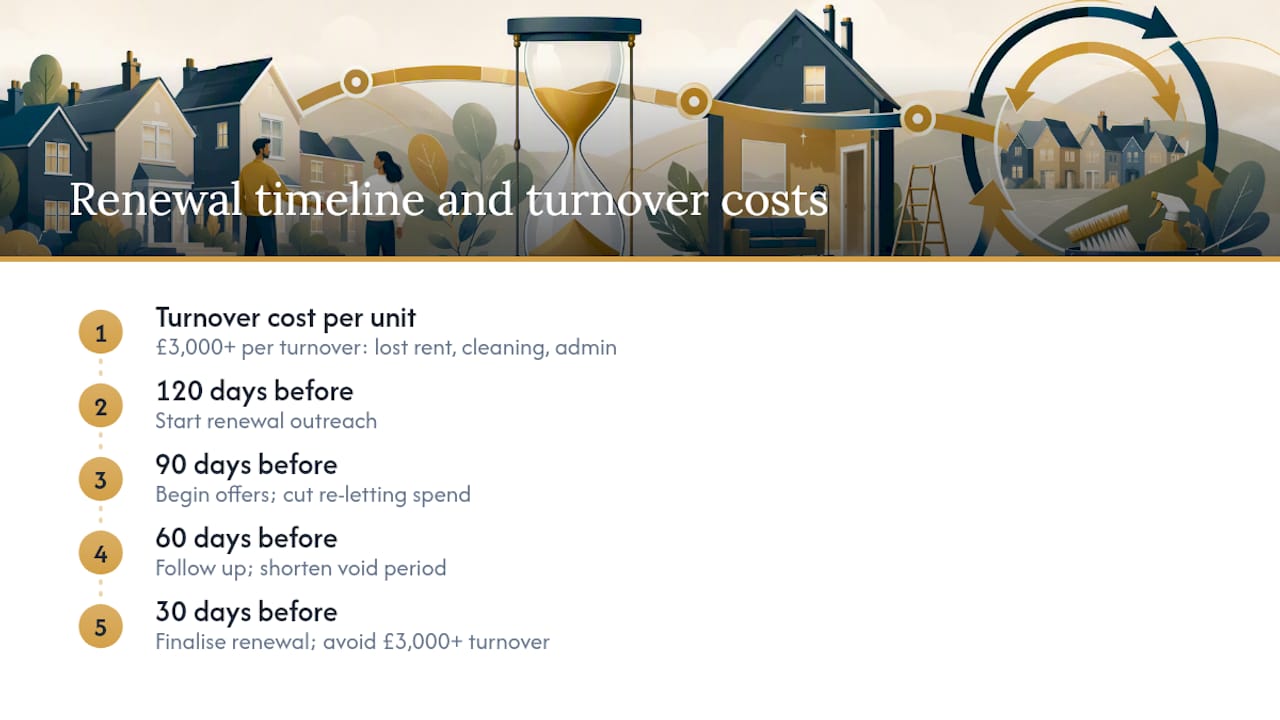
Statistic callout: Turnover often costs landlords £3,000+ per unit, and starting renewal outreach 90 to 120 days before lease expiry measurably reduces both vacancy days and re-letting spend.
Pro Tip: Calculate your own cost-per-turn once a year: add advertising spend, cleaning, referencing fees, and lost rent from the average void period, then divide by the number of turnovers. Set a portfolio-wide renewal-rate target based on that number, not on a generic industry benchmark.
The value isn't abstract. Predictable cashflow lets you plan mortgage payments and reinvestment with confidence, and fewer turnovers mean fewer emergency repair bills that always seem to surface right after a tenant leaves.
What Tenants Actually Want From a Landlord
Tenants don't leave because you didn't install a gym in the basement. They leave because the rent jumped too far, the boiler took two weeks to fix, or nobody answered their messages for days. Rent increases account for 37% of UK churn triggers, with poor night security at 29%, noise problems at 28%, unreliable internet at 18%, and slow repairs at 17%. Landlords who tackle several of these at once face a compounding churn risk, not just an additive one.
Some of these drivers sit within your control. Others don't.
- Highly controllable: maintenance speed, communication clarity, how a rent increase is framed and timed.
- Partially controllable: internet reliability (often landlord-installed but ISP-dependent), noise (lease terms and enforcement).
- Largely uncontrollable: broader market rent trends, a tenant's personal circumstances like a job relocation.
Where should limited budget go? Fixing the boiler faster beats installing a communal roof terrace almost every time. A rooftop lounge photographs well for the listing, but it rarely shows up in exit surveys as a reason someone stayed. Reliable heating, quick repairs, and a landlord who responds to a text within a day do.
Segmenting your tenants sharpens this further. Students often prioritize Wi-Fi speed and flexible break clauses around academic terms. Young professionals weight commute reliability and responsive maintenance heavily since they have less slack in their schedules. Families care most about school-term stability and safety features like working smoke alarms and secure windows. A one-size renewal offer misses all three groups; a tailored one speaks to what each actually values.

Building a Communication System That Doesn't Rely on You Remembering
Most landlord communication problems aren't personality problems. They're system problems. A tenant messages about a leaking tap, hears nothing for four days, and starts wondering if anyone's paying attention. That silence, more than the leak itself, is what erodes trust.
Set a simple SLA framework and stick to it:
- Emergency issues (no heating in winter, water leaks, security failures): acknowledge within 2 hours, contractor on-site within 24 hours.
- Urgent issues (broken appliance, minor leak): acknowledge within 24 hours, resolve within 3 to 5 days.
- Routine requests (cosmetic repairs, non-urgent queries): acknowledge within 48 hours, resolve within 1 to 2 weeks.
Match your channel to the message. A tenant portal works well for logging maintenance requests and tracking their status over time. SMS suits urgent, time-sensitive updates a tenant needs to see immediately. Email handles longer-form documents like lease renewal offers or compliance notices that benefit from a written record.
Several message types are worth automating outright: a maintenance request receipt the moment a ticket is logged, a renewal reminder at each stage of your timeline, and a move-in welcome message with key contacts and house information. Resident experience research consistently shows that communication alignment ranks alongside maintenance excellence as a primary retention lever, not a secondary nicety.
Pro Tip: Send a status update at every maintenance milestone, not just at completion. "Contractor booked for Thursday" costs you thirty seconds and prevents the follow-up chase message that eats your afternoon.
A short template list worth building out: move-in welcome, maintenance receipt, maintenance status update, maintenance completion, 120-day renewal notice, 90-day formal offer, 60-day follow-up, 30-day final reminder, and an annual rent review explainer. Draft these once, and every future tenant benefits from the consistency.
Turning Lease Renewals Into a Repeatable Process
A lease renewal shouldn't be a single letter that lands 30 days before expiry and hopes for the best. Treat it like a sales process with defined stages, because that's effectively what it is.
- 120 to 90 days out: open an informal conversation. Ask how the tenancy is going, flag any planned improvements, and gauge intent to stay.
- 90 days out: send the formal renewal offer, including any rent adjustment and the reasoning behind it.
- 60 days out: follow up if you haven't heard back. Address any hesitation directly rather than waiting.
- 30 days out: final reminder, with a clear deadline for a decision either way.
- If notice is given: begin remarketing immediately rather than waiting out the notice period, since early relisting shortens your void.
Offer examples that work without giving away margin: pair a modest rent increase with a tangible service improvement, such as a fresh coat of paint or an upgraded appliance, so the increase feels earned rather than arbitrary. A renewal bonus, like a one-off rent credit for signing 60 days early, rewards the behavior you want. Flexible lease terms, such as offering a 9-month option alongside the standard 12-month, can retain a tenant who'd otherwise leave over a rigid term mismatch.
Checklist for renewal outreach: property manager opens the conversation at 120 days, confirms market rent research by 100 days, sends the formal offer at 90 days, and logs every response in your tracking system so nothing falls through at the follow-up stage.
Small Gestures That Build Real Tenant Loyalty
Loyalty doesn't require a big budget. It requires a tenant feeling like more than a rent payment on your spreadsheet.
- A welcome pack on move-in day with local recommendations, emergency contacts, and a bin collection schedule costs almost nothing and sets the tone immediately.
- A short digital newsletter twice a year, covering any building updates or seasonal maintenance reminders, keeps you visible between transactions.
- Referral rewards, such as a £50 credit for a successful tenant introduction, tap into a network you'd otherwise pay an agency to access.
- On-time payment rewards, even something as simple as a small rent credit after 12 consecutive on-time payments, reinforce the relationship you want.
- Renewal credits, applied automatically when a tenant signs early, remove friction from the decision.
Zego's research found that 69% of renters say a rewards program would make them more likely to renew, with referral credits and rent discounts ranking as the most effective mechanics. That's a strong signal that these aren't cosmetic gestures. They influence real decisions.
Personalizing retention gestures for long-term tenants matters too. A tenant who's stayed three years deserves a different renewal conversation than someone on their first term, whether that's a small anniversary acknowledgment or first refusal on a property upgrade.

Maintenance and Inspections That Prevent Complaints Before They Start
Maintenance is the second most common controllable reason tenants leave, and the fix isn't complicated: respond fast, communicate clearly, and inspect before small problems become expensive ones.
- Set SLA targets by issue type. Emergencies (no heat, water ingress, security failures) get a contractor within 24 hours. Urgent issues (appliance failure, minor leaks) get resolved within 3 to 5 days. Routine requests get scheduled within 1 to 2 weeks.
- Notify tenants at every stage, not just when the job's done. A one-line message when a contractor is booked prevents three follow-up calls.
- Schedule inspections quarterly or twice yearly, checking heating systems, damp and condensation, smoke and carbon monoxide alarms, and communal area cleanliness.
- Log everything. A record of every request, response time, and resolution protects you in a dispute and shows a pattern of care if a tenant ever questions your responsiveness.
- Follow up a week after any major repair to confirm the fix held. This single step catches recurring problems before they become a reason to leave.
A short maintenance checklist worth pinning to your calendar: confirm smoke alarm function every 6 months, service the boiler annually ahead of the gas safety certificate renewal legislation.gov.uk requires, inspect for damp after any prolonged wet season, and review communal area condition monthly if you manage a multi-unit building.
Collecting Tenant Feedback Before Small Issues Become Move-Out Decisions
Waiting for a tenant to complain means you're always reacting. Structured feedback lets you catch problems while they're still cheap to fix.
Run surveys at four key moments:
- Move-in, 30 days: a short check on whether the property matched expectations and whether initial issues were resolved.
- Early experience, 60 to 90 days: gauge settling-in satisfaction and catch any recurring maintenance friction.
- Relationship check, 120 days: a Net Promoter Score question tells you how a tenant feels about the tenancy overall.
- Renewal stage, 60 to 90 days before expiry: the most important survey of all, since a low score here is your clearest warning that a tenant is weighing their options.
Retently's research on tenant satisfaction surveys recommends short, moment-triggered questions rather than one long annual form nobody finishes. A Customer Effort Score question ("How easy was it to get your maintenance issue resolved?") often reveals more than a generic satisfaction rating.
Handling a low score, or a Detractor in NPS terms, follows a clear path:
- The property manager reviews the response within 24 hours of it landing.
- A personal call or message goes out within 48 hours, not an automated acknowledgment.
- Any specific complaint gets a resolution deadline attached to it.
- A follow-up check happens two weeks later to confirm the fix held.
Zego's own findings emphasize that the most effective retention programs link survey alerts directly to operational escalation, so a bad survey response triggers action the same day, not at the next team meeting.
Getting Rent Increases and Lease Flexibility Right
Rent increases are the single largest churn trigger, but the goal isn't to freeze rent forever. It's to increase it in a way that doesn't feel like a slap.
The clearest threshold comes from Zego's research: renters begin seriously reconsidering renewal at an 8% rent increase, or when the monthly rise lands between £90 and £150, regardless of the base rent. A £1,500-a-month property pushing toward a £120 increase sits right in that danger zone. Calculate your planned increase against both the percentage and the flat pound figure before you send the offer, and check current market rates for context rather than guessing.
Incentives tied to specific behaviors work better than blanket discounts:
- A renewal credit for signing 60 days ahead of expiry rewards the early decision you want.
- A referral credit tied to a successful tenant introduction extends your network at low cost.
- An on-time payment perk, even something modest, reinforces reliability without discounting the base rent.
Flexible lease options matter more than many landlords assume. A tenant weighing a 12-month renewal against uncertainty about a job relocation might sign a 9-month term instead of not renewing at all. A break clause at month 6 costs you some certainty but often converts hesitation into a signed lease rather than a vacated property. Resonate CX's analysis of UK tenant behavior notes that landlords who nail the fundamentals, maintenance, safety, communication, can absorb measured rent increases without triggering churn, which is the strongest argument for getting the basics right before you touch the price.
Tracking the Numbers That Actually Predict Turnover
You can't improve what you don't measure, and retention is one of the easier things in property management to track consistently.
Review this dashboard monthly, with a named owner for each line. The property manager owns maintenance resolution time and SLA compliance. You, as the landlord, or your management company owns renewal rate and cost per turnover. Whoever handles tenant communication owns the survey scores.
The real value of tracking these numbers is the trigger they create. A missed SLA on maintenance resolution should prompt an outreach call to the affected tenant that same week, not a note for next month's review. A dip in renewal rate for a specific property should prompt a look at recent maintenance history and survey scores for that address specifically, not a portfolio-wide panic.
A Six-Month Retention Checklist You Can Start This Month
Turning strategy into habit means putting dates on the calendar. Here's a playbook that runs from move-in through the pre-renewal window.
- Move-in day: send the welcome pack, confirm the tenant's preferred communication channel, and log baseline property condition with photos.
- Month 1: check in informally to confirm everything's working as expected; resolve any snagging issues from move-in within the first two weeks.
- Months 2 to 3: send the early-experience survey, address any maintenance requests within your published SLA, and schedule the first routine inspection.
- Months 4 to 5: send the relationship NPS survey, review the tenant's payment history for any on-time reward eligibility, and start market rent research if renewal is approaching.
- 90 days before lease expiry: send the renewal survey, then follow with the formal renewal offer within the same week.
- 60 and 30 days before expiry: follow up on the renewal offer, and if no response, begin parallel remarketing prep as a safety net.
Owners and success metrics matter as much as the dates:
- The welcome pack and move-in checklist: property manager, success metric is 100% completion within 48 hours of move-in.
- Survey deployment: automated system or admin staff, success metric is a response rate above 40%.
- Renewal offer follow-through: landlord or letting agent, success metric is offer sent by day 90 without exception.
Templates and automation carry most of the weight here. Once your welcome pack, survey questions, and renewal letter templates exist, the workload per tenant drops sharply, and consistency across your portfolio goes up.
How Elite Tenancy Supports These Retention Tactics in Practice
Every tactic above depends on getting the right tenant in the door in the first place. A tenant who was never a strong fit for the property is far more likely to churn regardless of how well you run your maintenance SLA or renewal timeline.
Elite Tenancy's AI-driven matching is built around this exact problem, pairing landlords with tenants suited to the property from the start, which shortens average vacancy to around 14 days and reduces the mismatch risk that drives early move-outs.
A short, anonymized example: a landlord managing a two-bedroom flat in Manchester struggled with repeat six-month tenancies and the re-letting costs that came with them. After switching to a completion-only fee structure and AI-matched screening, the property held a tenant through a full 18-month term with no missed payments.
How the platform ties back to what you've read above:
- AI matching reduces the mismatch risk that leads to early, avoidable churn.
- Six-stage screening filters for tenants likely to pay reliably and communicate clearly, cutting dispute frequency.
- Automated communication tools support the SLA and renewal-timeline habits covered earlier without adding to your daily workload.
- Completion-only fees mean the cost of finding a tenant doesn't hit you until the placement succeeds, aligning the platform's incentive with yours.
What actually moves the needle, ranked
If you can only fix one thing this quarter, fix maintenance response time. It's the fastest way to show a tenant you're paying attention, and it's the churn driver most within your direct control. Communication systems come second, since a good SLA means nothing if tenants don't know it exists or can't reach you easily. Renewal timing comes third: even a strong maintenance record won't save a renewal that opens 20 days before expiry with a jarring rent increase attached. Measurement comes fourth, not because it matters least, but because you need the first three running before the data means anything.
One practical habit worth adopting: triage maintenance requests by perceived value, not just technical severity. A dripping tap ranks low on a contractor's urgency scale but ranks high on a tenant's daily irritation scale. Fixing the visible annoyance fast often buys you more goodwill than a technically "more urgent" repair the tenant never notices.
Before rolling any new offer or reward mechanic across your full portfolio, test it on a handful of properties first. A renewal credit that works for professional tenants in a city center flat might land differently with a family in a suburban house. Small experiments cost little and save you from a portfolio-wide misstep.
Let Elite Tenancy Handle the Match, So You Can Handle the Relationship
Every tactic in this guide works better when you start with the right tenant, and that's the part landlords struggle to control on their own. Elite Tenancy's AI matching and six-stage screening handle that upstream problem for you, so your maintenance SLA, renewal calendar, and reward program have a tenant worth investing in from day one.

Because Elite Tenancy charges a completion-only fee, you're not paying for advertising spend or agency time that doesn't result in a signed tenancy. That structure means the platform's incentive lines up with yours: get a well-matched tenant in place fast, then support the relationship that follows.
If you're managing a portfolio and want the matching, screening, and communication tools working together, visit the Elite Tenancy page for landlords to see how the service fits your properties. If you're ready to list now, you can list your property directly and start the matching process this week.
Frequently Asked Questions
What is the most effective tenant retention strategy for a small landlord?
Combining fast maintenance response with early renewal outreach delivers the most consistent results for landlords with just one or two properties, since neither requires significant budget, only consistency and a calendar reminder.
How early should I start the lease renewal conversation?
Begin informally at 90 to 120 days before expiry, with a formal offer following at the 90-day mark. Starting later than 60 days out significantly narrows your window to resolve any hesitation.
What rent increase is too much for tenant retention?
Renters typically start reconsidering renewal at an 8% increase or a monthly rise of £90 to £150, regardless of the base rent. Pairing any increase near that threshold with a visible service improvement softens the impact.
Do tenant loyalty programs actually work in residential letting?
Survey data suggests they do: 69% of renters say a rewards program would make them more likely to renew, with referral credits and rent discounts ranking as the most persuasive mechanics.
How do I measure whether my retention efforts are working?
Track renewal rate, average days vacant, cost per turnover, and a tenant satisfaction score monthly. A dip in any one of these should trigger a specific outreach action, not just a note for later review.
Sources
- 2026 Resident Experience Management Report | Zego
- 2026 Renter Preferences Report: Resident Impact & Business Performance
- Improve Tenant Retention in Real Estate Beyond Location | Resonate CX
- Tenant Satisfaction Surveys: The Questions to Ask Residents at Every Stage
- Hidden Cost of Turnover: 8 Tenant Retention Strategies | Buildium
Use these to benchmark your own renewal rate, cost per turnover, and survey scores against current UK figures rather than guessing at what "good" looks like.