
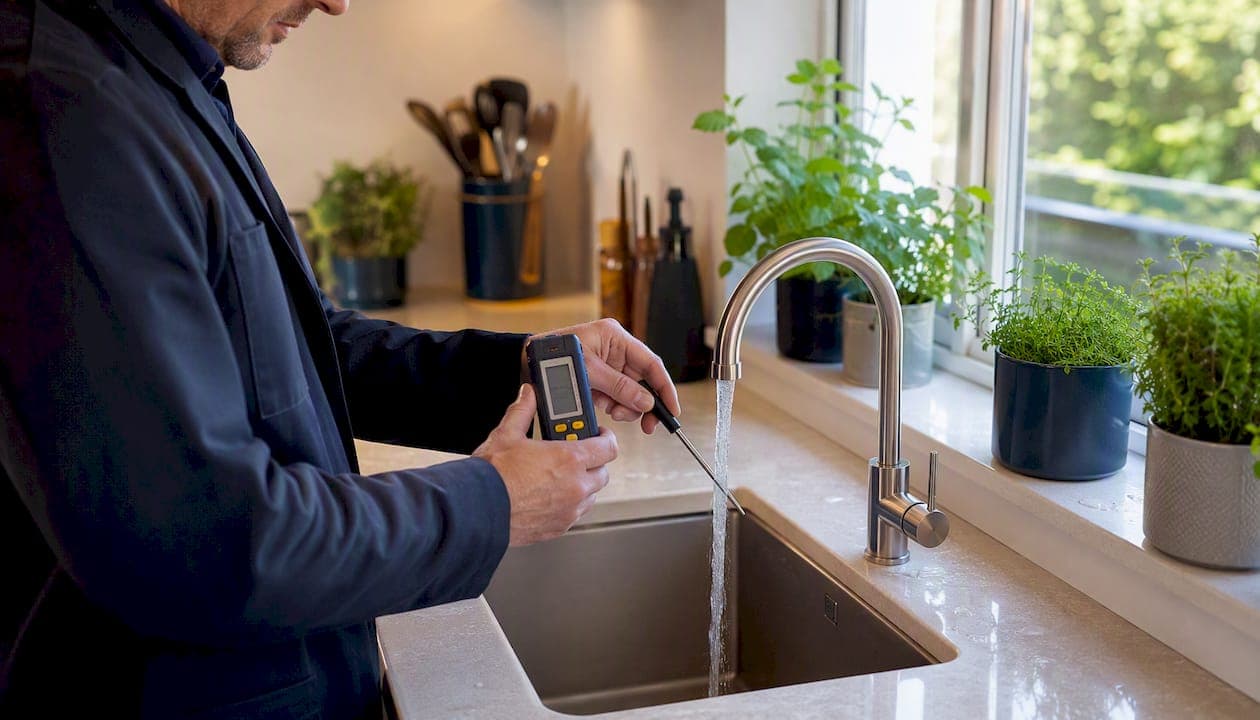
If you own or manage rental property in the UK, you must carry out a suitable and sufficient legionella risk assessment and control any risks that assessment identifies. That duty comes straight from the Health and Safety at Work etc. Act 1974, and it applies whether you own one flat or a portfolio of forty. For most standard domestic properties, this is not a job that requires a technical report full of jargon. It is a proportionate, practical check you can complete yourself if you understand the water system in question.
Here is what to do in the next 24 to 72 hours if you have not assessed your property recently:
- Flush any showerheads, taps, or outlets that have not been used for a week or more, running water for at least two minutes.
- Check your hot water cylinder thermostat is set to store water at 60°C.
- Inspect cold water storage tanks for tight, debris-free lids and confirm the water inside stays reasonably cool.
- Note down what you checked and when, even briefly. Documentation is what protects you if a dispute or inspection ever arises.
The ACOP L8 and HSG274 guidance set the standard dutyholders are measured against, and the HSE's dutyholder leaflet is the clearest starting point for what a proportionate assessment should record.
Key Takeaways
Landlords must complete a suitable and sufficient legionella risk assessment, control temperature at the source and outlet, and keep dated records to prove ongoing compliance.
| Point | Details |
|---|---|
| Legal duty is clear | The Health and Safety at Work etc. Act 1974 requires landlords to assess and control legionella risk. |
| Most landlords can self-assess | HSE allows landlords to complete assessments themselves if competent in the specific system. |
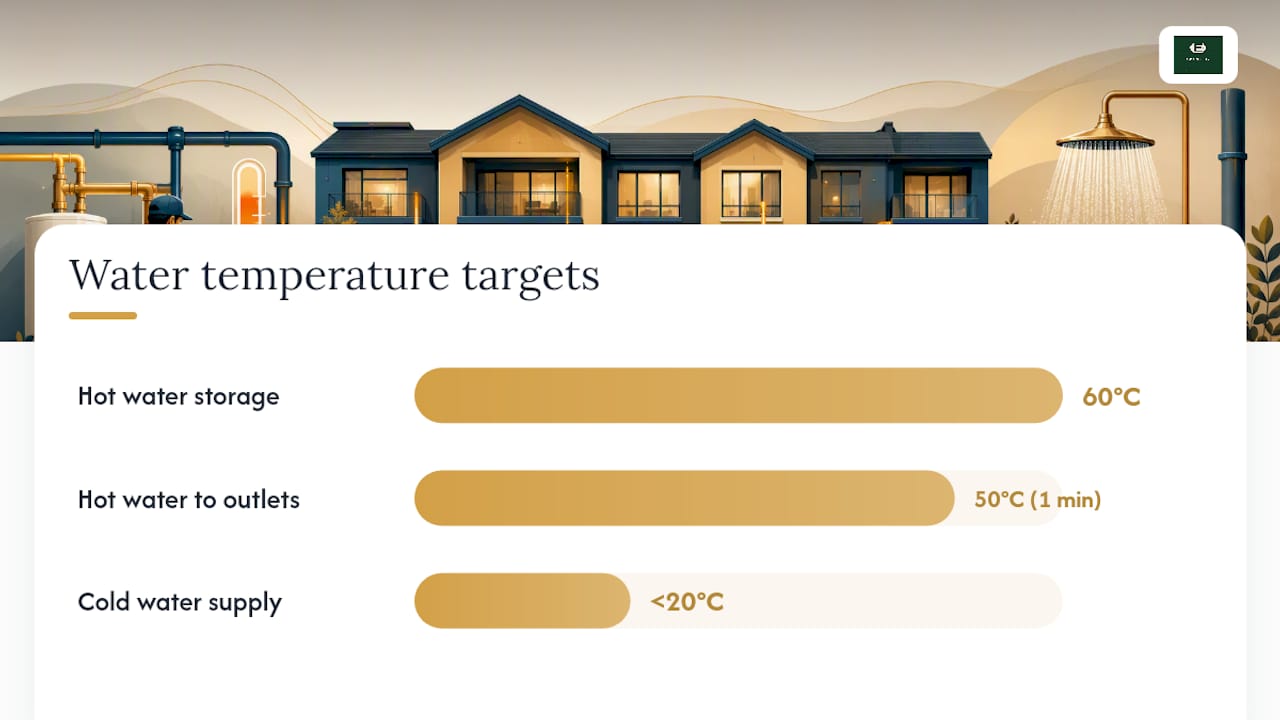
| Temperature is the main control | Store hot water at 60°C, deliver 50°C to outlets within one minute, keep cold water under 20°C. |
| Testing is the exception, not the rule | Microbiological sampling is only needed when controls fail or risk is elevated, not routinely. |
| Elite Tenancy supports ongoing compliance | Managed services fold legionella and other statutory checks into regular maintenance visits for landlords. |
This article is general information, not a substitute for advice from a qualified doctor. Consult a qualified healthcare professional about your own circumstances before acting on anything here.
Table of Contents
- What Is a Legionella Risk Assessment?
- What UK Law and Guidance Actually Require
- Who Can Actually Carry Out the Assessment?
- Step-by-Step Practical Assessment and Written Control Scheme
- Monitoring, Testing, and Recordkeeping Requirements
- Special Situations: Vacant Properties, HMOs, and Healthcare Settings
- When to Hire an External Legionella Consultant
- How Often Should You Review the Assessment?
- Ten Practical Actions Landlords Can Do This Week
- Why Practical Compliance Actually Protects Everyone
- Get Compliance Support Alongside Your Letting
- Sources
What Is a Legionella Risk Assessment?
A legionella risk assessment is a documented review of a property's water systems that identifies where legionella bacteria could grow and spread, then sets out how those risks are controlled. For a standard rental flat or house, that usually means looking at hot and cold water pipework, storage tanks, showers, and any outlets that go unused for long stretches. HSE guidance describes this as a "suitable and sufficient" assessment, meaning proportionate to the actual risk rather than exhaustive for its own sake.
The scope changes dramatically with system complexity. A single-let terraced house with a combi boiler and no water tank might need little more than a walkthrough and a few temperature checks. A hotel, HMO with communal water systems, hospital, or a building with a cooling tower needs a far more technical assessment covering recirculation loops, dead legs, and aerosol-generating equipment.
Examples that show the range:
- Simple domestic let: Combi boiler, no stored water, low occupant turnover. Assessment might take twenty minutes and confirm there is no significant risk.
- Older property with a tank: Requires checking tank condition, insulation, and temperature at outlets.
- HMO or student block: Shared risers, multiple bathrooms, and higher turnover mean a written scheme is almost always justified.
What UK Law and Guidance Actually Require
Several pieces of legislation and guidance work together to create your obligations, and it helps to know which one does what.
- Health and Safety at Work etc. Act 1974 creates the general duty to protect people, including tenants, from health risks arising from your property.
- Control of Substances Hazardous to Health Regulations (COSHH) classifies legionella bacteria as a hazardous substance requiring assessment and control.
- Management of Health and Safety at Work Regulations reinforce the requirement for a suitable and sufficient risk assessment process generally.
- ACOP L8 and its technical companion HSG274 translate those legal duties into specific, workable guidance: identify risks, prepare a written scheme where needed, monitor controls, and keep records.
If you own, manage, or otherwise control a rented premises, you are the "dutyholder" under this framework, regardless of whether you also live there. That responsibility cannot be quietly handed off to a letting agent or managing agent unless the contract explicitly assigns it and the agent actually acts on it.
One point trips up a lot of landlords: there is no single fixed review interval written into law that applies to every property. The guidance instead expects you to review the assessment whenever circumstances suggest it might no longer be accurate, a point worth remembering before you assume a five-year cycle covers you.
Who Can Actually Carry Out the Assessment?
You do not need to hire a specialist consultant to complete a legionella risk assessment for a standard rental property. HSE guidance confirms that a landlord can do the assessment themselves, provided they are competent for the specific system involved. Competence, in HSE's own words, means having "sufficient knowledge, skills and understanding" of that particular water system, not a formal certificate hanging on the wall.
- Straightforward combi boiler systems with no tanks: most landlords can assess these confidently after reading the dutyholder leaflet.
- Systems with cold water storage tanks, mixed pipework, or communal areas: consider whether you genuinely understand the layout before signing off yourself.
- Complex, multi-occupancy, or high-risk systems: bring in someone with demonstrable experience.
Pro Tip: Keep a simple folder, physical or digital, that includes the date of each check, what you tested, the reading, and your signature. If you ever need to demonstrate competence after an incident, that folder does more for you than any certificate.
Step-by-Step Practical Assessment and Written Control Scheme
A proper site survey follows a logical sequence, and skipping steps is how risks get missed. Start by describing the system itself: where water enters the property, how it is stored, and how it travels to each outlet. Draw or obtain a schematic, even a rough hand-drawn one, showing tanks, pipework runs, and every tap, shower, and outlet. This single document becomes the backbone of your written control scheme.
From there, walk the system looking specifically for:
- Storage tanks and cylinders, checking insulation, lids, and temperature.
- Recirculating hot water loops that might allow cooling in transit.
- Dead legs: sections of pipe with little or no flow, a classic breeding ground.
- Aerosol-forming outlets like showers, which pose a higher inhalation risk than taps.
Temperature is your primary control lever. HSE technical guidance sets clear targets: cold water should stay below 20°C where achievable, hot water should be stored at 60°C or above, and it should reach 50°C at the outlet within one minute of running (55°C in healthcare settings). Flushing infrequently used outlets weekly, for at least two minutes, prevents the stagnation that lets bacteria multiply.
A written control scheme, expected under ACOP L8 for anything beyond the simplest domestic system, should include:
- The system schematic and description.
- Named responsibilities: who checks what, and how often.
- Identified risk points and the specific controls in place for each.
- A monitoring schedule and a plan for what happens when a check fails.
| Timeframe | Priority Action |
|---|---|
| Immediate (this week) | Flush stagnant outlets, verify cylinder is at 60°C, check tank lids are secure |
| Medium term (this month) | Draw or update the system schematic, assign named responsibility, start a log |
| Longer term (this quarter) | Review insulation on pipework and tanks, assess any dead legs for removal, decide if a written scheme is warranted |
For a single flat with a combi boiler, this entire process might genuinely take under an hour. For a converted Victorian house with an old tank in the loft feeding three bathrooms, expect to spend real time on the schematic and monitoring plan.
Monitoring, Testing, and Recordkeeping Requirements
Temperature checks and visual inspections are your everyday tools; microbiological testing is not. HSE is explicit that sampling for legionella bacteria is not routinely required for domestic hot and cold water systems. Testing becomes relevant when your control measures are unreliable, when temperature targets cannot be consistently met, or when the system's complexity and occupant vulnerability raise the stakes, such as in healthcare settings where HSG274 Part 2 provides more detailed sampling guidance.
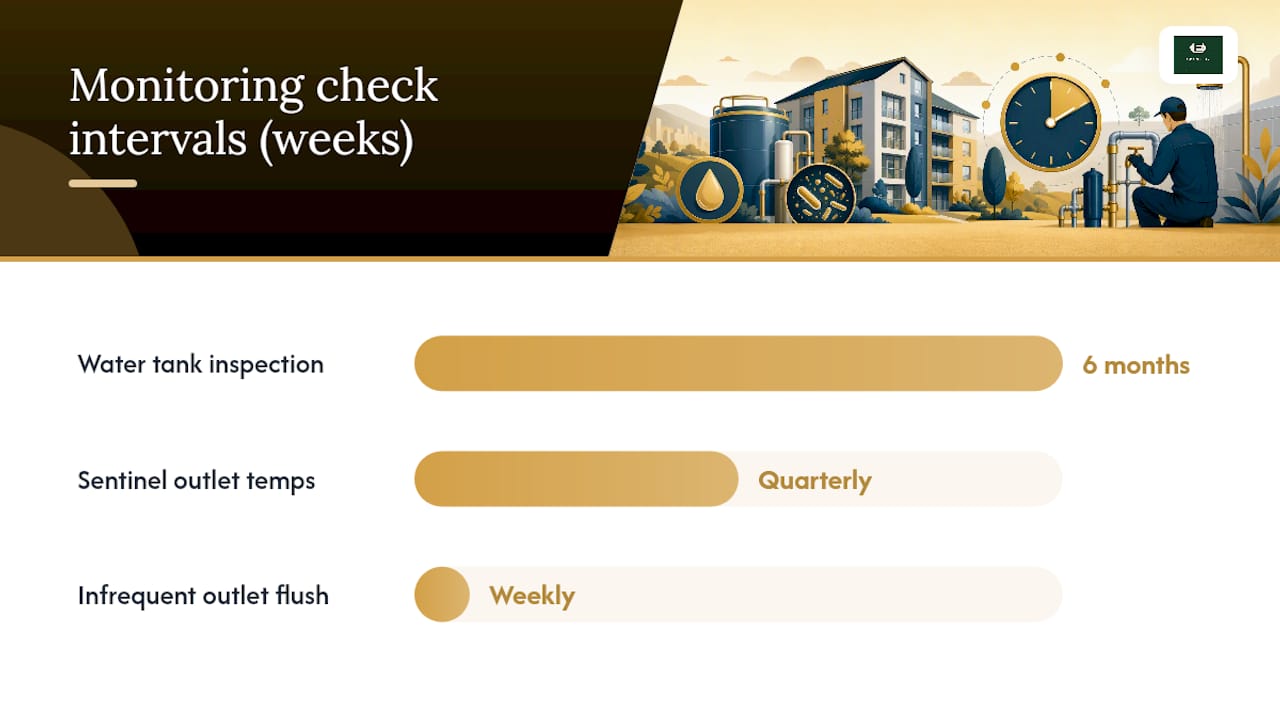
For most rented properties, a short monitoring rhythm covers the risk well:
| Item to Check | Suggested Frequency | Record to Keep |
|---|---|---|
| Sentinel outlet temperatures | Quarterly | Temperature reading, date, initials |
| Water tank inspection | Every six months | Condition notes, lid status, water clarity |
| Infrequently used outlet flush | Weekly, or before re-letting | Flush log entry |
| Written scheme review | On any system or occupancy change | Updated schematic and scheme document |
Retention guidance from HSE suggests keeping monitoring and inspection records for as long as they remain current, plus at least two years beyond that. Some landlords choose to hold onto older records longer, particularly for properties with a history of maintenance issues or previous tenant complaints.
Pro Tip: If you already schedule routine maintenance visits, gas safety checks, smoke alarm testing, general repairs, fold the legionella flush and temperature check into the same visit. You get compliance evidence without adding a separate trip to the property.
Special Situations: Vacant Properties, HMOs, and Healthcare Settings
Stagnant water is the enemy here, which makes vacant periods genuinely risky. A property left empty for weeks between tenancies gives bacteria time to establish, especially in warmer months. Before re-letting, flush every outlet thoroughly and recheck cylinder temperature; if the vacancy stretched beyond a couple of months, consider a fuller inspection before handing over keys.
HMOs and other multi-occupancy properties carry higher inherent risk because shared water systems serve more people with faster turnover, and communal pipework often includes longer runs and more dead legs than a single-family let. If you manage an HMO, expect that a written control scheme is close to mandatory rather than optional, and that your monitoring log needs to reflect the higher occupant churn.
Healthcare and care settings sit in their own category. Vulnerable residents mean HSE sets a higher outlet temperature target of 55°C rather than 50°C, and monitoring frequency increases accordingly, with HSG274's technical parts providing the detailed reference for these environments.
When to Hire an External Legionella Consultant
Most standard rental properties do not need a consultant. Certain situations, though, genuinely call for outside expertise:
- Complex systems: buildings with cooling towers, extensive recirculation loops, or multiple risers you cannot map confidently yourself.
- A confirmed or suspected case: any legionella diagnosis linked to your property warrants an immediate, thorough external review.
- Repeated control failures: if temperature checks keep coming back wrong despite your interventions, someone needs to find out why.
- Healthcare or care settings: the stakes and the technical requirements both justify specialist involvement.
- Genuine uncertainty about your own competence: if you cannot honestly say you understand the system, bring in help rather than guess.
Before appointing anyone, run through a short tender checklist:
- Ask for evidence of relevant experience with systems similar to yours, not just a general credential.
- Confirm they carry appropriate professional indemnity and public liability insurance.
- Request a sample risk assessment report to see how they document findings and actions.
- Get references from landlords or property managers they have worked with previously.
- Clarify the scope and deliverables in writing before work starts.
Watch for red flags: a report stuffed with technical jargon but no clear list of remedial actions, no proposed written control scheme, or no follow-up monitoring plan once the initial assessment is done. A good consultant leaves you with something you can actually act on, not just a document to file away.
How Often Should You Review the Assessment?
There is no single statutory interval that applies to every rental property; the honest answer is that you review it when circumstances give you reason to believe it no longer reflects reality. That is less satisfying than a fixed number, but it is what the guidance actually says.
Common triggers that should prompt a fresh look include:
- A change to the water system itself, new pipework, a replaced cylinder, or added outlets.
- New occupants, particularly if they include anyone more vulnerable to infection.
- A long vacancy, especially through warmer months.
- Any remedial works, plumbing repairs, or a suspected incident affecting the water supply.
As a rough practical guide, a quick check after any tenant turnover and a fuller review after system renovation covers most situations without turning compliance into a full-time job.
Ten Practical Actions Landlords Can Do This Week
- Check your hot water cylinder thermostat reads 60°C.
- Flush every outlet unused for a week or longer.
- Inspect tank lids for a tight, secure fit.
- Confirm cold water outlets run below 20°C where feasible.
- Draw a basic schematic of your water system.
- Name yourself or a specific person as responsible for checks.
- Start a simple dated log of what you inspected.
- Note any dead legs or rarely used pipework sections.
- Schedule the next check alongside your next maintenance visit.
- Review this list again before your next tenancy change.
For a fuller template you can adapt, Elite Tenancy's landlord resource hub covers related compliance checks worth pairing with this one.
Why Practical Compliance Actually Protects Everyone
Compliance paperwork means nothing if the underlying habits never change. What actually keeps tenants safe is consistency: the same flush, the same temperature check, the same log entry, month after month. Elite Tenancy builds compliance support into how we work with landlords precisely because the properties that stay problem-free are the ones where checks become routine rather than an annual scramble before an inspection. Simple, repeated actions beat occasional deep dives every time.
Get Compliance Support Alongside Your Letting
Handling legionella checks alongside gas safety, right to rent, and deposit compliance adds up fast for landlords managing more than one property. Elite Tenancy's Smart Managed and Premium Managed services fold routine water system checks into the same maintenance visits used for other statutory obligations, so you are not coordinating separate trades for separate checks. If you prefer to keep using an independent consultant for your legionella assessment, that works fine too. Our compliance management sits alongside whichever specialist you choose.
If you are weighing whether to self-manage or hand compliance over entirely, see how Elite Tenancy's landlord services work and get a sense of what fits your portfolio. Landlords who want a faster path to filling a vacancy once compliance is sorted can also request a free rental valuation to see what their property could achieve on the current market.
Sources
- Legionella and landlords' responsibilities - HSE