

UK GDPR applies to most landlords who process tenant data for lettings, whether you own one flat or a portfolio. The moment you keep applicant details, run credit checks, or store a scanned passport, you're a data controller under the law. Three things reduce your risk this week: run the ICO's self-assessment and pay the fee if it applies, map your tenant data and issue a privacy notice, and put a subject access request (SAR) and breach process in place before you need one.
You can knock all three out in an afternoon:
- Check the ICO fee tool and register if required.
- List every place tenant data lives (email, spreadsheets, cloud folders, paper files).
- Write a one-page privacy notice and save it where new applicants will see it.
Key Takeaways
GDPR compliance for landlords comes down to three habits: know your lawful basis, document what you hold, and respond fast when a tenant or the ICO asks a question.
| Point | Details |
|---|---|
| Confirm your status | Most landlords are data controllers and must run the ICO fee self-assessment. |
| Build a simple ROPA | Track what tenant data you hold, why, where, and for how long. |
| Meet the deadlines | Respond to SARs within one month and report qualifying breaches within 72 hours. |
| Match security to risk | Use encryption and two-factor authentication for ID scans and bank details. |
| Get help with the workload | Elite Tenancy's screening and reminder tools reduce the manual data handling that causes most landlord slip-ups. |
Table of Contents
- What UK GDPR Means for Landlords
- Does GDPR Apply to Me as a Landlord?
- Map Tenant Data and Keep a Record of Processing Activities
- Choosing a Lawful Basis for Processing Tenant Data
- Privacy Notices: What to Tell Tenants and When
- Do I Need to Pay the ICO Data Protection Fee?
- Practical Security Landlords Should Put in Place
- Handling Subject Access Requests and Tenant Rights
- Data Breaches: Detection, Containment, and the 72-Hour Rule
- Sharing Tenant Data With Agents and Contractors
- Retention: When to Delete or Anonymize Tenant Data
- What Happens If You Don't Comply
- Your Compliance Checklist for This Week
- A Publisher's Take on Landlord Data Practices
- How Elite Tenancy Supports Landlords With Data Protection
- Frequently Asked Questions
- Sources
What UK GDPR Means for Landlords
UK GDPR, sitting alongside the Data Protection Act 2018, governs how personal data gets collected, stored, and shared. The Information Commissioner's Office (ICO) enforces both. When you decide what tenant information to collect and why, you're a data controller, not just someone holding files for someone else.
That status brings three obligations landlords tend to underestimate:
- Pick a lawful basis before you process any tenant data, not after.
- Respect data subject rights: access, correction, deletion, objection.
- Keep evidence of your decisions, because accountability is now a legal duty, not a courtesy.
Does GDPR Apply to Me as a Landlord?
If you hold electronic tenancy agreements, run referencing checks, keep a spreadsheet of past applicants, or store a scan of someone's passport, you're in scope. These are everyday landlord tasks, not edge cases.
Using a letting agent changes things only partially. If the agent fully manages the tenancy and you receive nothing but a monthly statement, an accounts-and-records exemption may apply. But that exemption disappears the instant you receive electronic tenancy paperwork or keep your own applicant database, which is exactly what most landlords using an agent still do.
- Small portfolio size does not exempt you from the law.
- The ICO acts proportionately, but persistent or serious failures are still actionable.
- Instructing an agent while still making tenant selection decisions keeps you as a controller, not a processor.
Map Tenant Data and Keep a Record of Processing Activities
Building a Record of Processing Activities (ROPA) sounds bureaucratic, but it's really a spreadsheet that tracks what data you hold and why.
- List every data touchpoint from first enquiry to move-out: application forms, ID scans, reference checks, bank details, emails, and any CCTV footage from communal areas.
- Note the purpose and lawful basis next to each item.
- Record where it's stored and who can access it.
- Set a review date so the ROPA doesn't go stale.
| Data type | Purpose | Lawful basis | Storage | Retention |
|---|---|---|---|---|
| ID scan | Right-to-rent check | Legal obligation | Encrypted folder | Per current tenant's stay, plus statutory period |
| Bank details | Rent collection | Contract | Payment platform | Length of tenancy |
| Applicant reference | Selection decision | Legitimate interests | Spreadsheet | Short period post-decision |
Pro Tip: Date every ROPA entry and keep old versions rather than overwriting them. An auditor or tribunal wants to see that your practices evolved, not just what they look like today.
Choosing a Lawful Basis for Processing Tenant Data
You need a documented lawful basis for every category of tenant data you hold, and tenancy work maps cleanly onto three of the six available under UK GDPR.
| Lawful basis | Typical tenancy use | Example |
|---|---|---|
| Contract | Data needed to perform the tenancy agreement | Credit checks before signing |
| Legal obligation | Data required by statute | Right-to-rent verification |
| Legitimate interests | Data for your reasonable business needs | Keeping applicant records briefly for future vacancies |
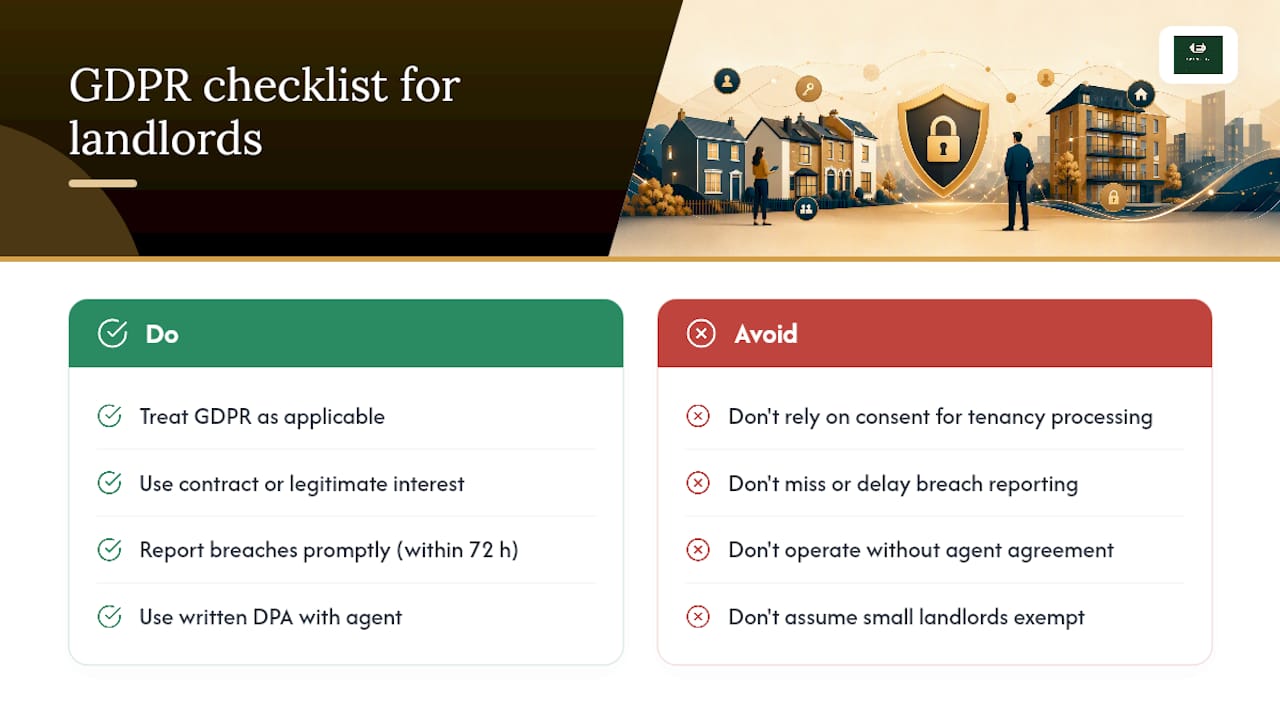
- Consent rarely suits core tenancy processes because withdrawing it would need to stop the processing, which isn't realistic for rent collection or referencing.
- Consent works fine for optional extras, like marketing emails about future properties.
- Whatever basis you choose, write it down. "We assumed it was fine" isn't a defense the ICO accepts.
Privacy Notices: What to Tell Tenants and When
A privacy notice needs to cover who you are, what you're collecting, why, who sees it, how long you keep it, and how tenants exercise their rights.
- State your identity as controller and how tenants can contact you about data.
- List purposes and lawful basis for each, in plain English, not legal boilerplate.
- Name any third parties you share data with, such as referencing agencies or agents.
- Give retention periods, even approximate ones.
Give this to applicants the moment you collect their information, and to tenants no later than sign-up. Burying it in page 14 of a tenancy agreement doesn't count as fair processing. Keep a dated record of when each tenant received it.
Do I Need to Pay the ICO Data Protection Fee?
If you produce electronic tenancy agreements, run credit checks, or keep an applicant database, you'll normally need to pay the ICO fee. Most self-managing landlords land in Tier 1.
- Paper-only operations with no digital records may fall outside the fee requirement, but this is rarer than landlords assume.
- Instructing an agent doesn't automatically exempt you if you still hold applicant data or make selection calls yourself.
- Run the ICO self-assessment, confirm your tier, and set up a direct debit for the renewal discount.
Pro Tip: Keep your fee confirmation email somewhere permanent. It's useful evidence if a dispute or tenancy tribunal ever questions your compliance history.
Practical Security Landlords Should Put in Place
ICO guidance takes a risk-based approach to security: the more sensitive the data, the stronger the protection needed. ID documents, bank details, and any health or disability information call for tighter controls than a general enquiry log.
A short list you can act on today:
- Enable two-factor authentication on email and cloud storage accounts holding tenant files.
- Encrypt devices and folders containing ID scans or financial details.
- Use strong, unique passwords and a password manager rather than reused logins.
- Lock paper files in a cabinet, not a drawer anyone in the building can open.
For CCTV covering communal areas, post clear signage, limit footage retention, and restrict access to those who genuinely need it.
- Test your backups occasionally, not just when you need them.
- Write a one-page internal policy so security decisions aren't just in your head.
- Physical breaches count too: a stolen paper file exposing tenant data is as reportable as a hacked email account.
Handling Subject Access Requests and Tenant Rights
Tenants can ask what data you hold on them, and you have one calendar month to respond. Extensions apply only for genuinely complex requests, and the clock still starts from the day you receive it.
- Acknowledge the request and confirm you're processing it.
- Verify the requester's identity before releasing anything.
- Search all your systems, including old emails and spreadsheets.
- Redact any third-party information that isn't the requester's own data.
- Deliver securely and log the dates at every stage.
Tenants also have rights to rectification, erasure, restriction, and objection. Erasure requests often come up after a tenancy ends; objection tends to surface around marketing communications.
Data Breaches: Detection, Containment, and the 72-Hour Rule
A lost unencrypted laptop, a misdirected email containing tenant ID, or a leaked bank detail all count as reportable breaches if they create risk to someone's rights and freedoms.
- Contain the breach immediately: revoke access, recall the email, change passwords.
- Investigate internally to understand scope and cause.
- Report to the ICO within 72 hours of becoming aware, if the risk threshold is met.
- Update the ICO as your investigation develops.
- Notify affected tenants directly when the breach poses a high risk to them, explaining what happened and what you're doing about it.
- Keep an internal breach log even for incidents you decide not to report, since the ICO can ask why you made that call.
- The Data (Use and Access) Act 2025 added a duty to acknowledge data protection complaints within 30 days starting June 2026, tightening the window landlords have to respond.
Sharing Tenant Data With Agents and Contractors
Whether your agent is a joint controller or a processor changes who's responsible for notices and rights requests, so pin this down before data starts flowing.
- Confirm who decides why and how the data gets used, not just who handles the paperwork.
- Put a written agreement in place covering scope, security guarantees, audit rights, and what happens to data when the contract ends.
- Ask processors directly about their security certifications and breach reporting commitments before you sign anything.
- Referencing companies and contractors need the same scrutiny as agents.
- Verbal assurances aren't enough; get commitments in writing.
Retention: When to Delete or Anonymize Tenant Data
Keep only what you genuinely need, and say for how long in both your privacy notice and your ROPA.
- Records tied to deposit disputes or tax matters often need several years' retention to match statutory limitation periods.
- Unsuccessful applicant data should be held only briefly, then deleted.
- Shred paper records and use secure deletion tools for digital files rather than just hitting delete.
What Happens If You Don't Comply
Consequences range from tenant complaints and reputational damage to ICO enforcement action, including fines up to statutory ceilings, plus civil claims for distress or financial loss.
- Most small landlords who slip up get warned and advised first, not fined outright.
- Persistent or willful non-compliance is treated far more seriously.
- Keeping records, notices, and a security policy in place is your best practical defense if a complaint ever lands.
Your Compliance Checklist for This Week
Prioritize these five in order, and you'll cover the bulk of what the ICO expects from an ordinary landlord.
- Run the ICO self-assessment and pay the fee if it applies.
- Draft and issue a privacy notice to every applicant and tenant.
- Build a simple ROPA covering data from enquiry to move-out.
- Put basic security measures in place: encryption, 2FA, locked files.
- Write a one-page SAR and breach response process, even a short one.
| Task | Deadline |
|---|---|
| SAR response | One calendar month from receipt |
| Breach report to ICO | Within 72 hours if risk threshold met |
| ICO fee renewal | Annually |
Document what you did and when. That paper trail is what protects you if a tenant complains or a dispute ends up in front of a tribunal.
A Publisher's Take on Landlord Data Practices
Compliance work rewards landlords who treat it as ordinary admin rather than a legal minefield. The paperwork you build now, a privacy notice, a ROPA, a documented lawful basis, does double duty: it satisfies the ICO, and it becomes evidence if you ever need to defend a possession claim or a tenancy dispute under the newer reforms reshaping the sector. Landlords who skip this step aren't usually reckless; they just never got a simple checklist to follow.
How Elite Tenancy Supports Landlords With Data Protection
Elite Tenancy handles the paperwork burden that trips up most self-managing landlords, so GDPR compliance stops being a side project you never get to. Its six-stage tenant screening keeps applicant data secure and structured from the first enquiry, and automated right-to-rent reminders mean expiry checks don't fall through the cracks between busy weeks.

Because Elite Tenancy only charges once a tenancy is successfully placed, there's no ongoing retainer eating into your margin while you sort out privacy notices and retention schedules on your own time. If you'd rather have secure listing, screening, and recordkeeping handled properly from day one, list your property with Elite Tenancy and see how the process works before your next vacancy.
Frequently Asked Questions
Does GDPR really apply to a single landlord with one property? Yes. Scope depends on what data you process and how, not how many properties you own. One landlord with a spreadsheet of applicant details is still a data controller.
What's the difference between UK GDPR and the Data Protection Act 2018? UK GDPR sets the core rules; the Data Protection Act 2018 supplements it with UK-specific detail and enforcement powers for the ICO.
Can I use consent as my lawful basis for tenancy data? Rarely, for core processes like referencing or rent collection, because tenants can't realistically refuse and still get the tenancy. Contract or legitimate interests usually fit better; consent suits optional marketing.
What happens if I miss the 72-hour breach reporting window? Late reporting can itself draw ICO criticism, even if the breach turns out to be minor. Report as soon as you assess a genuine risk, and document your reasoning either way.
Do I need a written agreement with my letting agent? Yes, if they process tenant data on your behalf. A clear agreement covering security, breach reporting, and data return protects both parties if something goes wrong.
This article is general information, not a substitute for advice from a qualified lawyer. Consult a qualified legal professional about your own circumstances before acting on anything here.
Sources
- UK GDPR & Data Protection Act 2018: Landlord Guide | TAS | Tenancy Agreement Service
- FSP Law: Subject access requests — how quickly should I reply?
Run the ICO self-assessment today and save the confirmation. It's the single easiest piece of evidence to have on file.