

AI property management means using software and agentic workflows to automate the repetitive parts of running rental properties, including tenant communication, maintenance triage, lease review, and portfolio analytics, while your rules and data controls stay firmly in charge. It does not replace your judgment on who to house or how to handle a dispute. It removes the busywork that eats your week so you can focus on the decisions that actually need a human.
Two facts ground this. AI and technology now let property managers redirect their time toward client service, tenant satisfaction, and sustainability improvements rather than paperwork. And by 2026, the category has split into two tiers: basic chatbots at one end, and agentic systems that handle lease abstraction, maintenance orchestration, and portfolio analytics at the other.
If you manage anywhere from a handful of units to a large portfolio, start smaller than you think you need to. Pilot one narrow workflow, tenant inquiry triage or maintenance request routing, for 60 to 90 days before touching anything else.
- Quick win to expect: faster first-response times on tenant inquiries, often the difference between capturing a lead and losing it to a competing listing.
- What not to automate yet: final screening decisions, lease terminations, or anything with legal weight until you've built confidence in the tool's judgment.
- Fastest path to value: a single, well-scoped workflow beats a platform-wide rollout every time.
Pro Tip: Pick the workflow with the highest volume of routine, low-stakes interactions first. Tenant communication almost always wins that contest, because most inquiries are repetitive ("is the property still available," "when is rent due," "can I bring a pet") and don't require nuanced judgment.
Key Takeaways
AI property management works best when it automates one narrow, repeatable workflow at a time, with human review built into every stage that involves judgment or risk.
| Point | Details |
|---|---|
| Start with one workflow | Pilot tenant communication or maintenance triage before touching screening or lease decisions. |
| Ask vendors about errors | Require a real example of an AI mistake and how a human caught it during the demo. |
| Track four core KPIs | Measure response time, vacancy days, maintenance resolution time, and cost per lead. |
| Watch for lock-in | Avoid contracts with no clean data export path if you switch vendors later. |
| Elite Tenancy as the proof point | Its AI matching and six-stage screening fill vacancies in an average of 14 days with a completion-only fee and under 0.3% default acceptance. |
Table of Contents
- What Are the Core AI Use Cases in Property Management?
- How Do You Evaluate an AI Property Management Tool?
- How Does AI Integrate With Your Existing Property Management System?
- What Does a 90 to 180 Day AI Pilot Actually Look Like?
- What Does AI Property Management Cost, and How Do You Measure ROI?
- What Are the Data and Compliance Risks of AI Property Management?
- How Elite Tenancy Uses AI to Cut Vacancy Time
- Let Elite Tenancy Run Your AI Matching and Screening
- Sources
What Are the Core AI Use Cases in Property Management?
Six use cases account for most of the practical value property managers get from AI today. Each one works because it targets a narrow, repeatable task rather than trying to replace end-to-end decision-making.
Tenant communication and 24/7 triage. An AI agent answers routine phone, text, and email inquiries around the clock, qualifying leads and scheduling viewings without a human touching the first exchange. Products like Avenir center their entire pitch on collapsing phone, text, and maintenance requests into one structured record, and Haven builds "AI workers" that specifically handle leasing follow-up across channels. The measurable benefit is response time: inquiries answered in minutes rather than hours convert into viewings at a meaningfully higher rate, simply because fewer prospective tenants wander off to the next listing.
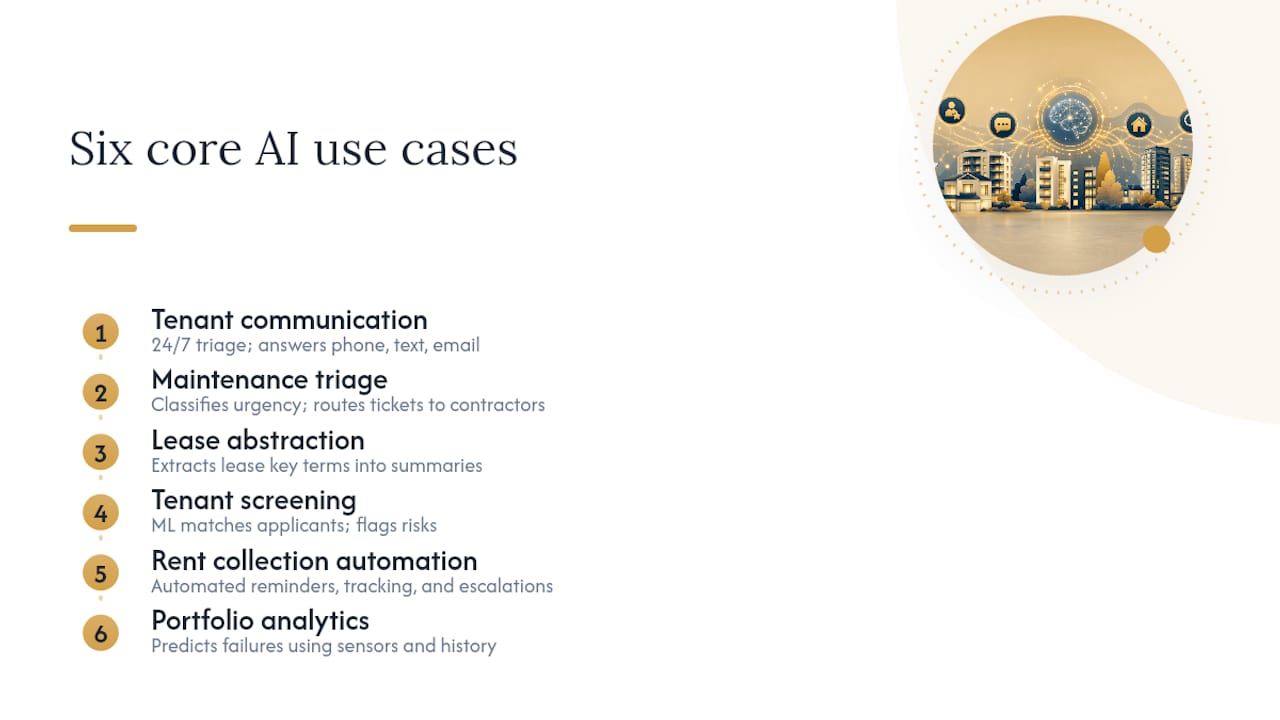
Maintenance triage and vendor routing. A tenant reports a leak by text; the system classifies urgency, pulls the property's maintenance history, and routes the ticket to the right contractor automatically. Entrata frames this as part of an "agentic operating system" that runs autonomous workflows with policy guardrails, meaning the AI can act within limits you set rather than escalating everything to a human. The payoff shows up in resolution time, since urgent issues (no heat, burst pipes) get flagged and dispatched immediately instead of sitting in a shared inbox.
Lease abstraction and contract summarization. Instead of a manager reading a 40-page lease to find the pet clause or the renewal notice period, AI extracts key terms into a searchable summary in seconds. This matters most for portfolios with mixed lease templates or inherited properties where nobody remembers what was negotiated.

Tenant screening and matching. Machine learning models cross-reference applicant data, references, and rental history against a defined criteria set, flagging matches and risks faster than manual review. This is where the stakes are highest, since a biased or opaque matching process creates both legal exposure and reputational damage.
Rent collection and arrears automation. Automated reminders, payment tracking, and structured escalation sequences reduce the manual chasing that consumes hours every month, particularly across portfolios with dozens of individual tenancies on different payment dates.
Portfolio analytics and predictive maintenance. Sensor data and historical repair patterns let AI flag which units are likely to need attention before a tenant even calls, based on usage patterns and equipment age.
For a small team managing under 50 units, tenant communication is almost always the right first pilot. It requires the least integration work and produces the fastest, most visible win. For a large portfolio operator managing hundreds of doors, maintenance triage and vendor routing tend to pay off faster, since the volume of tickets makes even small efficiency gains compound quickly.
How Do You Evaluate an AI Property Management Tool?
Most procurement mistakes in this category come from evaluating AI tools the way you'd evaluate ordinary software, which misses the questions that actually matter: how the system handles your data, what happens when it's wrong, and whether you can leave if it doesn't work out.
Run every vendor conversation through this checklist:
- Data integration: Does it connect to your existing property management system (PMS), accounting software, and CRM without a manual export/import step?
- Policy guardrails: Can you define hard limits on what the AI can do autonomously versus what requires human sign-off?
- Audit trails: Does every automated action get logged with a timestamp and reasoning, so you can reconstruct a decision if a tenant disputes it?
- Model explainability: Can the vendor explain, in plain terms, why the system flagged or approved a specific applicant or ticket?
- Pricing model: Subscription, per-unit, per-interaction, or success-fee, and does that model scale sensibly as your portfolio grows or shrinks?
- Service levels: What's the guaranteed uptime and support response time, especially for maintenance triage running around the clock?
- Onboarding and references: Will they provide references from portfolios similar in size to yours, not just their biggest logo customer?
- Compliance: Does the tool have documented handling for regional data protection rules and fair-housing type screening obligations?
During a demo, ask the vendor directly: "Show me an example where your AI made an incorrect decision, and walk me through how a human caught it." A vendor with a mature product will have a real answer. One without a good answer is telling you something.
Watch for these red flags: a vendor that's cagey about where your tenant data is stored or processed, no audit trail for automated decisions, sales reps who dodge questions about model errors, and any contract that locks your data into their format with no clean export path if you switch providers later.
The distinction between "native AI" and "bolt-on AI" matters more than it sounds. Platforms built with AI as a core layer rather than an add-on tend to unify data across teams and produce more consistent operational outcomes, whereas automation stapled onto legacy software often creates duplicate data entry and inconsistent records.
| Evaluation dimension | What to look for |
|---|---|
| Primary use case / strength | Communications, maintenance, analytics, or matching, matched to your biggest operational bottleneck |
| Pricing model | Subscription, per-unit, per-interaction, or success-fee tied to outcomes |
| Integration surface | Native connections to your PMS, accounting, and CRM versus manual workarounds |
| Data and privacy safeguards | Encryption standards, access controls, audit logging, and data residency |
| Best for | Small portfolios needing simple triage versus large operators needing multi-workflow orchestration |
How Does AI Integrate With Your Existing Property Management System?
AI in property management rarely replaces your core PMS. It sits as a layer above it, pulling data in and pushing structured actions back out.
A typical architecture looks like this: your property management system holds the system of record, leases, rent rolls, and payment history. An AI agent connects to that system, plus your phone lines, SMS gateway, and email, then adds a layer of autonomous or semi-autonomous action on top, guided by rules you configure. Some setups also pull in IoT sensor data for predictive maintenance, catching a failing water heater before it floods a unit.
Here's what each connector typically contributes to the system:
| Connector | What it supplies |
|---|---|
| Property management system (PMS) | Lease terms, rent rolls, payment history, unit status |
| Accounting software | Financial reconciliation, invoice matching, arrears tracking |
| CRM | Lead history, prospect communication logs, follow-up sequencing |
| Listing sites | Vacancy syndication, inquiry capture, applicant data intake |
| Vendor/contractor portals | Work order dispatch, job status updates, invoice submission |
| IoT sensors | Real-time alerts on temperature, moisture, or equipment performance |
Vendors like Tivio advertise dozens of pre-built workflows spanning leasing, communications, maintenance, and finance, which reflects how broad this integration surface has become across the category.
The safest way to start a pilot is a read-only sync paired with policy-driven actions. Let the AI read your PMS and CRM data without write access at first, and limit its autonomous actions to low-stakes tasks like sending a scheduling confirmation or logging a maintenance request. Expand its write permissions only after you've watched it operate correctly for a few weeks. This limits your exposure if the integration has a bug or the AI misinterprets a data field, since nothing gets overwritten or sent incorrectly while you're still learning how the system behaves.
What Does a 90 to 180 Day AI Pilot Actually Look Like?
A pilot that leads to a real go/no-go decision needs structure, not just enthusiasm. A practical timeline spreads discovery, configuration, training, live testing, measurement, decision-making, and scaling over a few months.
Set your success thresholds before the pilot starts, not after you see the results. Reasonable targets include significantly faster response times, stable tenant satisfaction, and timely resolution of maintenance tickets.
Assign clear ownership before you go live. Someone on your team needs to own the data feeding into the AI system, someone needs to review a sample of its outputs regularly, and the vendor needs a documented responsibility for uptime and error correction. Without this grid, accountability quietly evaporates the moment something goes wrong, and nobody's sure whose job it was to catch it.
- Data ownership: your team, not the vendor, should control what data feeds the system.
- Output review: assign one person to spot-check AI decisions weekly, minimum.
- Escalation rules: define in writing what triggers an automatic handoff to a human.
What Does AI Property Management Cost, and How Do You Measure ROI?
Pricing in this category tends to follow one of four models, and each has different implications for how costs scale with your portfolio.
Subscription pricing charges a flat monthly fee regardless of portfolio size, which works well for smaller operators but can feel like you're overpaying once you've outgrown the plan's usage limits. Per-unit or per-door pricing scales with your portfolio directly, which keeps costs proportional but means growth always comes with a cost increase attached. Per-interaction pricing charges based on volume of tenant communications or maintenance tickets processed, which rewards efficiency but can spike unpredictably during a busy leasing season. Success-fee pricing ties cost to outcomes, like a placed tenancy or resolved maintenance ticket, aligning vendor incentives with your results but usually costing more per successful outcome than a flat subscription.
Beyond the headline fee, budget for these items:
- Implementation and setup fees, often waived or discounted for smaller portfolios.
- Integration work if your PMS or accounting software needs custom connectors.
- Data clean-up, since AI performs poorly against messy or duplicate tenant records.
- Staff training time, even if it's light.
- Ongoing vendor management, since someone needs to own the relationship and flag issues.
A simple ROI template: take your current cost of the manual task (staff hours spent on tenant communication per week, multiplied by hourly cost) and compare it against the AI tool's monthly fee plus the reduced staff hours after automation. Add in the value of vacancy days saved, since faster response times to prospective tenants translate directly into shorter time-to-let. Track four metrics consistently: vacancy days reduced, time-on-task savings for your staff, maintenance cost reductions from faster triage, and the speed of new tenancies being let.
The broader payoff isn't just efficiency. Redirecting staff time away from repetitive tasks toward tenant relationships and sustainability initiatives tends to show up in retention rates over a longer horizon, even when it's harder to capture in a single monthly ROI figure.
What Are the Data and Compliance Risks of AI Property Management?
The risks in this category cluster around five areas, and each one has a practical mitigation you can put in place before you go live.
Data leakage happens when tenant information gets exposed through poor access controls or an insecure integration. Mitigate it with encryption at rest and in transit, plus role-based access so only staff who need tenant data can see it.
Resident privacy concerns arise when AI systems collect more data than necessary or retain it longer than needed. Set clear data retention policies and only capture what the workflow actually requires.
Biased screening decisions are the most serious risk in this list, since an AI model trained on flawed historical data can quietly replicate discriminatory patterns in tenant matching. Require manual-review checkpoints on every screening decision until you've validated the model's outputs against your own fair-housing obligations over a meaningful sample size.
Regulatory compliance gaps show up when a vendor's tool wasn't built with your jurisdiction's rules in mind. If you operate in the UK, keep your right to rent checks and evolving tenancy regulations, including the Renters' Rights Act, in view when configuring any automated compliance step.
Vendor lock-in and operational resilience risks come from contracts that make it hard to export your data or switch providers. Insist on clear SLAs and an exit provision before signing.
A short due-diligence checklist before onboarding any vendor:
- Where is tenant data stored, and under what jurisdiction's data protection law?
- What's the data export process if you terminate the contract?
- How often is the screening or matching model audited for bias?
- Who is liable if an automated action causes a tenant dispute or regulatory breach?
This is general guidance, not legal advice. Confirm current compliance obligations with a qualified professional or the relevant regulatory body before finalizing any AI vendor contract.
How do property managers handle a tenant dispute caused by an AI decision? Most mature vendors build in a documented override process, where a human reviews the flagged case and the audit trail shows exactly what data the AI used to reach its original decision.
Is AI tenant screening legal? Screening automation is legal in the UK when it complies with data protection and fair-housing obligations, but the legality depends on how the model is built and reviewed, not the fact that it's automated. Confirm your specific setup with a qualified advisor.
How Elite Tenancy Uses AI to Cut Vacancy Time
Elite Tenancy's own matching workflow illustrates what a well-scoped AI pilot looks like once it's running at scale, not just in a demo.
The workflow pairs AI-driven tenant matching with a six-stage screening process, so applicants are cross-referenced against property requirements before a landlord ever sees a shortlist.
The completion-only fee structure means the incentive lines up with the outcome you actually want: a properly vetted tenant in place, not a fee collected regardless of result.
A practitioner's perspective on what works
The biggest mistake I see in AI adoption is over-automation. Teams get excited after a good demo and try to hand the AI every workflow at once, including final screening decisions and lease terminations, before anyone's validated how it performs on their own data. That's backwards. The tools that actually earn trust are the ones given a narrow job first, watched closely, and expanded only once they've proven themselves on low-stakes tasks.
The second mistake is skipping governance. If nobody owns the data quality feeding the system, and nobody's assigned to review outputs regularly, the AI drifts into decisions nobody's actually checking. The single most useful thing you can do for adoption is pair every automated workflow with one named person responsible for spot-checking it weekly, not indefinitely, just until you trust the pattern.
Delay a rollout if your tenant and lease data is messy or inconsistent across systems, if you don't have someone clearly accountable for reviewing AI decisions, or if you haven't defined a measurable KPI you'll use to judge success. Rolling out without those three things in place almost always produces a pilot you can't actually evaluate.
Let Elite Tenancy Run Your AI Matching and Screening
Elite Tenancy gives landlords the outcome this article has been describing without asking them to evaluate, configure, or manage an AI vendor themselves. You get the AI matching, the six-stage screening, and the compliance monitoring bundled into one service, with a fee structure that only charges you once a tenant is placed.

The platform's AI tenant matching is what drives the average 14-day fill time, cross-referencing applicant profiles against your property's requirements far faster than manual shortlisting. For landlords who also want ongoing compliance support, including right to rent reminders and automated rent collection, Elite Tenancy's managed tiers extend the same AI-driven approach beyond the initial let.
If you're a landlord looking to fill a vacancy without hunting for a tenant screening vendor yourself, list your property with Elite Tenancy and let the matching and screening process run for you from the first inquiry to the signed tenancy.
Sources
Recommended
- Platform Features | Elite Tenancy
- The Elite Tenancy AI Matching System: How It Works
- Transparent Lettings Pricing | Elite Tenancy
- Landlord's Complete Guide to Letting in 2026: Compliance, Yields & Finding Tenants
Made with BabyLoveGrowth to reach more people through search